 1964: 1963 Rickenbacker 360-12 Fire-glo
(binding top and back, triangle inlays, trapeze tail
piece). Serial No. CM107. Just after the Beatles
arrived in New York for their first Sullivan appearance,
Harrison took to bed at the Plaza Hotel with a cold and
sore throat while the rest of the lads larked about in
Manhattan. One of their stops was the Savoy Hilton
Hotel, where Rickenbacker president F.C. Hall had
arranged with Brian Epstein to show the band some new
instruments, one of them this electric 12-string he'd
just developed. Lennon tried it out and suggested
Harrison might like it, so the party moved back to the
Plaza, where Hall gave Harrison this guitar. 1964: 1963 Rickenbacker 360-12 Fire-glo
(binding top and back, triangle inlays, trapeze tail
piece). Serial No. CM107. Just after the Beatles
arrived in New York for their first Sullivan appearance,
Harrison took to bed at the Plaza Hotel with a cold and
sore throat while the rest of the lads larked about in
Manhattan. One of their stops was the Savoy Hilton
Hotel, where Rickenbacker president F.C. Hall had
arranged with Brian Epstein to show the band some new
instruments, one of them this electric 12-string he'd
just developed. Lennon tried it out and suggested
Harrison might like it, so the party moved back to the
Plaza, where Hall gave Harrison this guitar. 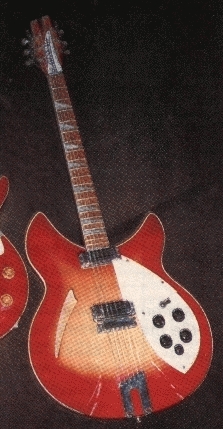 At the time Harrison was on the phone,
doing an interview with radio station WDGY in
Minneapolis, and as Harrison tried out the instrument,
the DJ offered to buy it for him. But Hall had come to
give Harrison the instrument, so that was
that. Harrison started using this guitar
directly the band returned to England, first for "I
Should Have Known Better," February 25, followed by "I
Call Your Name" on March 1 and "A Hard Day´s
Night" on April 16. With the arrival
of his second 360-12 a year and a half later, Harrison
retired this trend-setting instrument. At the time Harrison was on the phone,
doing an interview with radio station WDGY in
Minneapolis, and as Harrison tried out the instrument,
the DJ offered to buy it for him. But Hall had come to
give Harrison the instrument, so that was
that. Harrison started using this guitar
directly the band returned to England, first for "I
Should Have Known Better," February 25, followed by "I
Call Your Name" on March 1 and "A Hard Day´s
Night" on April 16. With the arrival
of his second 360-12 a year and a half later, Harrison
retired this trend-setting instrument.
Note: Harrison
dusted off this guitar for 1987's Cloud Nine,
where he played it on "Fish on the Sand." At
left, in a photo taken by Harrison: the
360-12 today. Rickenbacker plans to offer a
faithful reissue of this guitar. |
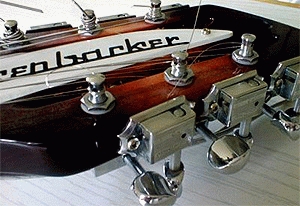 The octave- and root-string tuners are
located very close to each other, but at a right angle
and not in a row as on traditional 12-strings; this
makes it easier to see which string you're actually
tuning. The machine heads are, of course, identical on
the sides and the back. The Rickenbacker
12-string setup is different from any other that I
know of. If you are strumming downstrokes you
will hit the lower string (tone) first. A normal
12-string has the octave string at the top."
The octave- and root-string tuners are
located very close to each other, but at a right angle
and not in a row as on traditional 12-strings; this
makes it easier to see which string you're actually
tuning. The machine heads are, of course, identical on
the sides and the back. The Rickenbacker
12-string setup is different from any other that I
know of. If you are strumming downstrokes you
will hit the lower string (tone) first. A normal
12-string has the octave string at the top."