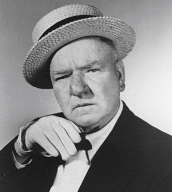
 William
Claude
Dukenfield was born Jan.
29, 1880 in Darby, Pennsylvania, just across the
Philadelphia city line. The eldest of the five children
of James Dukenfield, an English immigrant, and Kate
Felton, a native Philadelphian, Fields lived -- to hear
him tell it in later years -- a Huck Finn sort of
childhood in which he left home at age 11 (after
smashing a crate over his father's head) and survived by
his wits, sleeping in a ditch or on a pool table,
stealing food and staying one step ahead of the
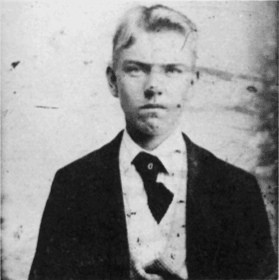
constable. But in fact, "Whitey" Dukenfield, as the
blond youth was nicknamed, often squabbled with his
father, but he lived with the family until age 18. William
Claude
Dukenfield was born Jan.
29, 1880 in Darby, Pennsylvania, just across the
Philadelphia city line. The eldest of the five children
of James Dukenfield, an English immigrant, and Kate
Felton, a native Philadelphian, Fields lived -- to hear
him tell it in later years -- a Huck Finn sort of
childhood in which he left home at age 11 (after
smashing a crate over his father's head) and survived by
his wits, sleeping in a ditch or on a pool table,
stealing food and staying one step ahead of the
constable. But in fact, "Whitey" Dukenfield, as the
blond youth was nicknamed, often squabbled with his
father, but he lived with the family until age 18.
Having left school somewhere around sixth grade, he'd worked with his father hawking fruits and vegetables, in addition to other jobs in a cigar store, a pool hall, a newsstand and a department store. More typically, Whitey could be found at one of Philly's several variety theaters, for he had taken a keen interest in juggling. Touring the circuits then were such notables as Charles T. Aldritch and O.K. Sato, Comedy Juggler, but one in particular seems to have inspired the boy most: Paul Cinquevalle, the Prince of Jugglers, a mustachioed American showman who juggled plates, cannon balls, umbrellas, even tables and chairs.
A stint with a traveling burlesque show followed, which ended when the show's manager abandoned the troupe in Kent, Ohio. But Fields had fallen for a chorus girl, Hattie Hughes; he married her and made her his assistant. For the next couple years Fields played burlesque circuits in the East and Midwest, advancing steadily toward the top of the bill. In 1901 he made his first tour of Europe, and his silent Tramp Juggler act was a hit wherever he played. In 1903 Fields added his trademark routine, the trick pool table, and it wasn't long before critics heralded him as the greatest comedy juggler of his generation. Fields began his self-education around this time, filling a steamer trunk with volumes of the classics -- Dickens, Twain, Hardy, Milton, Shakespeare, Dumas -- and reading them voraciously between performances.
It was during these years that Fields, equipped with a little clip-on mustache, made his ventures into silent film, commencing with Pool Sharks (1915). Except for Sally of the Sawdust (D. W. Griffith's 1925 filmed version of Poppy), these early films fared poorly with critics and at the box office. It was also during these years that Fields gave up on his marriage and began a series of relationships with chorus girls. One of these led to an illegitimate son, William Rexford Fields Morris, born in 1917 to Bessie Poole, a Follies dancer. Poole gave the boy up for adoption and died 10 years later in a bar fight. (Fields had had Poole sign a document stating he was in no way responsible for the child, but in fact he supported the boy through adulthood. Morris would later track down Fields in Hollywood and show up at his door, asking to see his father. Fields reportedly instructed his butler: "Give him an evasive answer. Tell him to go fuck himself.") In 1930, Fields made his first "talkie," The Golf Specialist, for RKO (at a New Jersey studio), featuring the golf routine he'd made famous in the Vanities and in a silent film, So's Your Old Man, and for the first time film audiences heard his distinctive, raspy drawl. The next year, with the popularity of sound pictures and the death of Vaudeville, Fields moved to Hollywood and soon found a home at Paramount Pictures. He stole the show in 1932's Million Dollar Legs, an oddball comedy about a nation of Olympic-calibre athletes, but tentative studio executives kept trying to "pair him up" with other comic actors like Alison Skipworth and Charlie Ruggles. In 1932 and 1933, Fields moonlighted with director Mack Sennett to make four shorts that would showcase Fields' stage routines: The Dentist, The Fatal Glass of Beer (a re-working of "The Stolen Bonds"), The Pharmacist and The Barber Shop.
By 1936 his drinking caught up with him, and he tried to "dry out" a couple times. Paramount wouldn't renew his contract, so he accepted radio guest appearances (notably with ventriloquist Edgar Bergen and his dummy, Charlie McCarthy) that, to his surprise and delight, made him more popular than ever. In 1939, back on his feet, he negotiated a deal with Universal Studios, where he would make his most famous films: You Can't Cheat an Honest Man (with Bergen and McCarthy); My Little Chickadee, with Mae West co-writing the script; The Bank Dick, and Never Give a Sucker an Even Break (both described below).
After a protracted court battle,
Fields' wife Hattie was awarded his estate, valued at
more than $700,000. His mistress of many years,
Carlotta Monti, and his illegitimate son went home
empty handed. Although rumored to have dictated an
epitaph -- "On the Whole, I'd Rather Be in
Philadelphia" -- Fields' columbarium niche at Forest
Lawn in Glendale, California simply reads "W.C. Fields
/ 1880-1946." |
 Young Dukenfield began practicing
fervently, starting with his father's produce, and
worked up routines with balls, hats, cigar boxes and a
cane. Thanks to his tenure at the pool hall, he also
perfected a host of billiards tricks. But, determined
to make his act stand out, Dukenfield added touches of
comedy to his juggling, like "accidentally" dropping
an object, only to deftly snatch it on the rebound or
send it caroming off a startled assistant and back
into the flow. In January 1898 he began performing at
local Masons halls and such venues as "Wm. C. Felton"
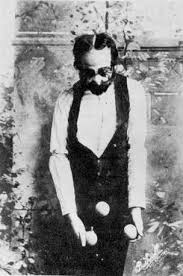
but soon -- attired in tattered clothes and fake beard
-- became "W.C. Fields, Tramp Juggler." By August of
that year he'd secured a job at Plymouth Park, an
amusement park in Norristown, PA. Proprietor J.
Fortescue soon moved the popular young juggler to his
Atlantic City venue, Fortescue's Pavillion.
Young Dukenfield began practicing
fervently, starting with his father's produce, and
worked up routines with balls, hats, cigar boxes and a
cane. Thanks to his tenure at the pool hall, he also
perfected a host of billiards tricks. But, determined
to make his act stand out, Dukenfield added touches of
comedy to his juggling, like "accidentally" dropping
an object, only to deftly snatch it on the rebound or
send it caroming off a startled assistant and back
into the flow. In January 1898 he began performing at
local Masons halls and such venues as "Wm. C. Felton"
but soon -- attired in tattered clothes and fake beard
-- became "W.C. Fields, Tramp Juggler." By August of
that year he'd secured a job at Plymouth Park, an
amusement park in Norristown, PA. Proprietor J.
Fortescue soon moved the popular young juggler to his
Atlantic City venue, Fortescue's Pavillion.
 When Hattie became pregnant, Fields
dispatched her to Philadelphia. She would never return
to the stage, for it seemed she now preferred a more
"respectable" lifestyle, and for the next 30 years
Fields would send her a weekly check, although never
an amount to her satisfaction. Hattie converted to
Catholicism and did the same for their son, Claude,
which further angered Fields, who felt religion was
"for chumps," and the couple's relationship became a
battlefield. Fields' later films would reflect this
domestic anguish. But Fields, now in the highest rank
of entertainment, continued to tour the world until
1915, when he settled in New York and began a long
tenure with Flo Zigfield's Follies, co-starring with
such luminaries as Al Jolson, Ed Wynn, Leon Errol,
Bert Williams, Fanny Brice and Will Rogers. In this
venue he juggled some but concentrated on developing
comedy routines, most of which would later show up on
film, such as A Game of Golf, The Back Porch, The
Picnic, and The Stolen Bonds. He also appeared in
competing revues such as George White's Scandals and
Earl Carroll's Vanities. In 1923 Fields starred in a
Broadway hit, Poppy, as Professor
Eustace McGargle, F.A.S.N., a character into which
Fields was able to funnel his experiences with con
men, medicine show characters, fairground barkers and
the like. Blended with a dollop of his Dickensian
favorite Mr. Micawber, this synthesis formed one of
the two charcters (besides the henpecked pater
familias) that Fields would play from here on.
When Hattie became pregnant, Fields
dispatched her to Philadelphia. She would never return
to the stage, for it seemed she now preferred a more
"respectable" lifestyle, and for the next 30 years
Fields would send her a weekly check, although never
an amount to her satisfaction. Hattie converted to
Catholicism and did the same for their son, Claude,
which further angered Fields, who felt religion was
"for chumps," and the couple's relationship became a
battlefield. Fields' later films would reflect this
domestic anguish. But Fields, now in the highest rank
of entertainment, continued to tour the world until
1915, when he settled in New York and began a long
tenure with Flo Zigfield's Follies, co-starring with
such luminaries as Al Jolson, Ed Wynn, Leon Errol,
Bert Williams, Fanny Brice and Will Rogers. In this
venue he juggled some but concentrated on developing
comedy routines, most of which would later show up on
film, such as A Game of Golf, The Back Porch, The
Picnic, and The Stolen Bonds. He also appeared in
competing revues such as George White's Scandals and
Earl Carroll's Vanities. In 1923 Fields starred in a
Broadway hit, Poppy, as Professor
Eustace McGargle, F.A.S.N., a character into which
Fields was able to funnel his experiences with con
men, medicine show characters, fairground barkers and
the like. Blended with a dollop of his Dickensian
favorite Mr. Micawber, this synthesis formed one of
the two charcters (besides the henpecked pater
familias) that Fields would play from here on.
 But back at Paramount, Fields
gradually brought studio execs around, confounding
them when he launched into ad-lib but mollyfying them
with good reviews. In 1933, he stole the show in International
House as Prof. Quayle, a "wrong-way
Corrigan" who lands his autogyro on a hotel roof in
China. Before long he'd wrested creative control of
his films from the studio and began to rework some of
his silent films. Though flops the first time around,
these remakes began to catch on: You're Telling
Me, a remake of So's Your Old Man(1926);
It's A Gift , from The Old Army
Game (1926); Man on the Flying
Trapeze, from Running Wild (1927),
and Poppy. And in 1935 he prevailed
upon Paramount to lend him to MGM to play his favorite
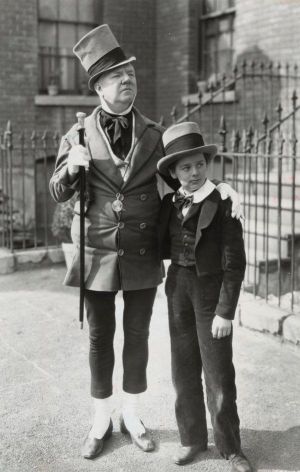
Dickens character, Micawber, in David
Copperfield, a performance critics
universally praised.
But back at Paramount, Fields
gradually brought studio execs around, confounding
them when he launched into ad-lib but mollyfying them
with good reviews. In 1933, he stole the show in International
House as Prof. Quayle, a "wrong-way
Corrigan" who lands his autogyro on a hotel roof in
China. Before long he'd wrested creative control of
his films from the studio and began to rework some of
his silent films. Though flops the first time around,
these remakes began to catch on: You're Telling
Me, a remake of So's Your Old Man(1926);
It's A Gift , from The Old Army
Game (1926); Man on the Flying
Trapeze, from Running Wild (1927),
and Poppy. And in 1935 he prevailed
upon Paramount to lend him to MGM to play his favorite
Dickens character, Micawber, in David
Copperfield, a performance critics
universally praised. 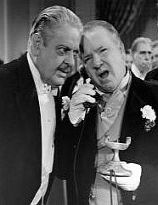 But Fields ignored his doctors' pleas
for moderation, and his health once again
deteriorated, and except for a few more cameo roles at
other studios, W.C. Fields' career had come to an end.
In 1945, crippled by arthritis and weakened by
cirrhosis of the liver, he moved out of his Bel Air
home into nearby Las Encinas Sanitarium, where in
December 1946 he lapsed into a coma. He came out of it
on Christmas Day long enough to wink to the friends
gathered around his bed, then surrendered to "the man
in the bright nightgown," as Fields had often
characterized the Grim Reaper.
But Fields ignored his doctors' pleas
for moderation, and his health once again
deteriorated, and except for a few more cameo roles at
other studios, W.C. Fields' career had come to an end.
In 1945, crippled by arthritis and weakened by
cirrhosis of the liver, he moved out of his Bel Air
home into nearby Las Encinas Sanitarium, where in
December 1946 he lapsed into a coma. He came out of it
on Christmas Day long enough to wink to the friends
gathered around his bed, then surrendered to "the man
in the bright nightgown," as Fields had often
characterized the Grim Reaper. 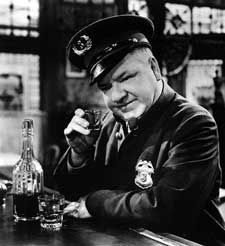
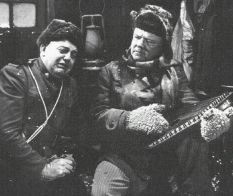 Man on the
Flying Trapeze (1935): not a circus
picture, actually the tale of Ambrose Wolfinger, a
henpecked "memory expert" who reports his
mother-in-law dead to get the afternoon off to go to a
wrestling match. This neglected masterpiece features
Fields' mistress, Carlotta Monti, as his secretary; The Old Fashioned Way (1934):
The Great McGonigle and his "happy little family of
the theatre" put on The Drunkard in a backwater town.
One priceless act of this "show within a show" is a
recreation of Fields' juggling act, complete with the
legendary cigar-box trick; The
Bank Dick (1940): layabout Egbert Sousé
lucks into a job as security officer at a bank where
his daughter's fiance works. He persuades the lad to
embezzle $500 to invest in a beefsteak mine. Stanley
Kubrick listed this as one of his favorite films; Never Give a Sucker an Even Break
(1941): Fields' last major work, a quirky broadside at
Hollywood. Fields plays himself in battle with a film
producer, trying to sell a script wherein he jumps out
of an airplane after his flask and lands unharmed in a
Russian village in Mexico. There he woos the rich Mrs.
Hemoglobin (Margaret Dumont), who lives atop a
mountain with her virginal daughter (Susan Miller, who
belts out a show-stopping version of "Comin' Thro' the
Rye"). One of Federico Fellini's favorite films.
Man on the
Flying Trapeze (1935): not a circus
picture, actually the tale of Ambrose Wolfinger, a
henpecked "memory expert" who reports his
mother-in-law dead to get the afternoon off to go to a
wrestling match. This neglected masterpiece features
Fields' mistress, Carlotta Monti, as his secretary; The Old Fashioned Way (1934):
The Great McGonigle and his "happy little family of
the theatre" put on The Drunkard in a backwater town.
One priceless act of this "show within a show" is a
recreation of Fields' juggling act, complete with the
legendary cigar-box trick; The
Bank Dick (1940): layabout Egbert Sousé
lucks into a job as security officer at a bank where
his daughter's fiance works. He persuades the lad to
embezzle $500 to invest in a beefsteak mine. Stanley
Kubrick listed this as one of his favorite films; Never Give a Sucker an Even Break
(1941): Fields' last major work, a quirky broadside at
Hollywood. Fields plays himself in battle with a film
producer, trying to sell a script wherein he jumps out
of an airplane after his flask and lands unharmed in a
Russian village in Mexico. There he woos the rich Mrs.
Hemoglobin (Margaret Dumont), who lives atop a
mountain with her virginal daughter (Susan Miller, who
belts out a show-stopping version of "Comin' Thro' the
Rye"). One of Federico Fellini's favorite films.