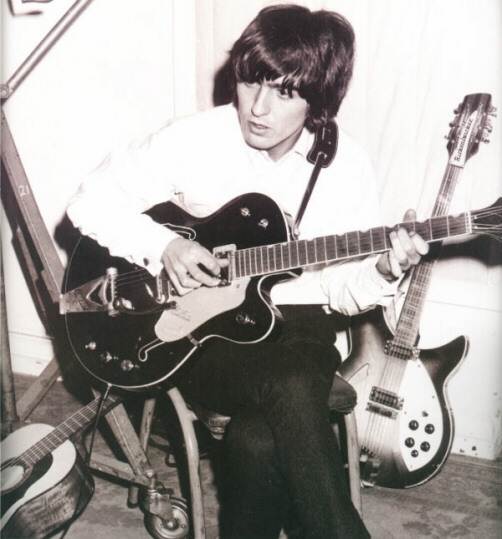
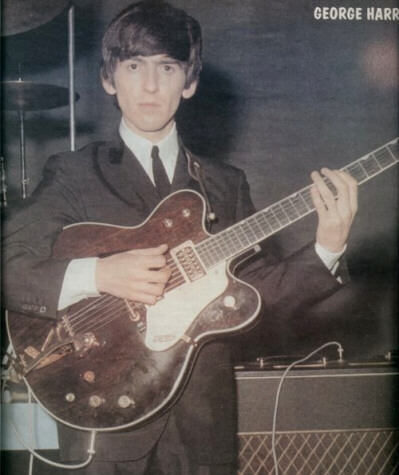
 1963: 1962 Gretsch 6122 Country Gentleman
(walnut finish) gold hardware, Neo-Classic inlays,
dial-up mutes, Gretsch Bigsby vibrato, two Filter'Tron
pickups: In May Harrison upgraded to this more
deluxe Gretsch he found at Sound City London, and after
removing the mutes -- and later the bass-side screw-up
knob -- used it extensively for touring and recording
(first on "She Loves You" and then With The
Beatles). It's also seen
in the famous Royal Command performance. When this
guitar went into the shop for repair, Sound City gave
him another one (below), but while in the shop this
first Gent was stolen. It was later recovered, and
Harrison, preferring his second Gent, relegated this one
to backup duty. (Both Gents are photographed
together at a November '63 gig.) 1963: 1962 Gretsch 6122 Country Gentleman
(walnut finish) gold hardware, Neo-Classic inlays,
dial-up mutes, Gretsch Bigsby vibrato, two Filter'Tron
pickups: In May Harrison upgraded to this more
deluxe Gretsch he found at Sound City London, and after
removing the mutes -- and later the bass-side screw-up
knob -- used it extensively for touring and recording
(first on "She Loves You" and then With The
Beatles). It's also seen
in the famous Royal Command performance. When this
guitar went into the shop for repair, Sound City gave
him another one (below), but while in the shop this
first Gent was stolen. It was later recovered, and
Harrison, preferring his second Gent, relegated this one
to backup duty. (Both Gents are photographed
together at a November '63 gig.)
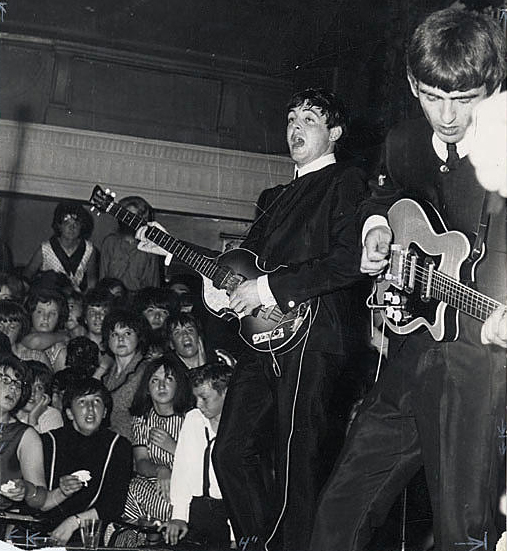
This Gent met its fate on a roadway. On 2 December 65 the Beatles' limo, bound for Glascow for the first stop of the band's last British tour, hit a bump at Berwick on Tweed. This first Gent had been lashed to the boot (trunk) and came untied, and it wound up on the road. When Ringo Starr noticed a trucker flashing his lights, he notified the driver, Alf Bicknell, who pulled over. "You've just lost a banjo back down the road," the trucker told Alf. Alf broke the news to Lennon, who told him that if he found the banjo, the driver would get a bonus -- he could keep his job. Alf doubled back and found it -- in pieces -- but kept his job anyway. As the band was in a hurry, they left the pieces in the road and kept going. 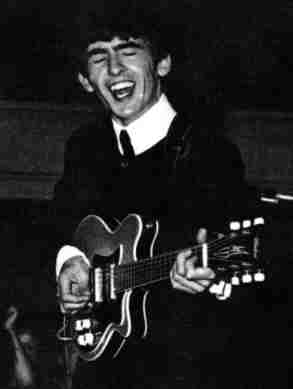 1963: Maton Mastersound MS-500 (vintage
unknown): Before Harrison's first Gent went into
the Sound City shop, it needed repairs during a May
visit to Manchester, where he borrowed this Australian
solidbody from Barratt's of Manchester and used it for a
few performances. It shows up in photos from
shows at the Grafton Rooms, Liverpool, on 12 June and
the Winter Gardens, Margate, in early July. After
that, Harrison reportedly returned the guitar to the
shop, where, according to a recent story in the
Liverpool Echo, "a few weeks later, Roy
Barber, rhythm guitarist for Dave Berry's backing band
The Cruisers, swapped his Fender Stratocaster for a
Maton at Barratt's store and was told by the owner it
was the one recently used by Harrison. Barber
stopped using . . . the guitar several years later and
for 20 years it lay abandoned in its case in the attic
of his home in Totley, Sheffield. After his death
aged 55 in 2000, Barber's widow Val loaned it to the
National Centre for Popular Music in Sheffield."
Mrs. Barber, who stated her desire to send her son to
Cambridge, put this guitar up for auction in June
2002. "There is no doubt in anyone's mind that
this was the guitar which George Harrison played," Mrs.
Barber asserted in the Echo piece, "but
it would be great if the person from Barratt's could
come forward to verify it 100 per cent." One
eventually did: Brian Higham, the former manager
of the shop, who wrote that Neil Aspinall brought the
Gent in for machine-head repairs, a job which Higham did
himself. The guitar didn't go at
aution, but a sale was subsequently brokered by Music
Ground, which apparently bought the Maton from Mrs.
Barber and sold it to Englishman John Marks for
£35,000. Marks explained that he is "collecting
famously owned guitars for an investment, and to open a
museum in Malta to benefit a childrens charity."
After the sale Marks got another of The Hollies, Eric
Haydock, to sign a letter
stating Haydock remembers the band's road manager,
Johnny MacDonald, being asked to deliver the Maton to
Harrison. Fast-forward to 2015, when it was
auctioned again, by Julien's, for $485,000. Not a
bad appreciation. And in 2018, it went up for sale again
through the Gardiner Houlgate auction house, selling for
about $450,000 to an "overseas private collector" via
telephone bid. Curiously, it seems not to have had
appreciated since the previous sale! 1963: Maton Mastersound MS-500 (vintage
unknown): Before Harrison's first Gent went into
the Sound City shop, it needed repairs during a May
visit to Manchester, where he borrowed this Australian
solidbody from Barratt's of Manchester and used it for a
few performances. It shows up in photos from
shows at the Grafton Rooms, Liverpool, on 12 June and
the Winter Gardens, Margate, in early July. After
that, Harrison reportedly returned the guitar to the
shop, where, according to a recent story in the
Liverpool Echo, "a few weeks later, Roy
Barber, rhythm guitarist for Dave Berry's backing band
The Cruisers, swapped his Fender Stratocaster for a
Maton at Barratt's store and was told by the owner it
was the one recently used by Harrison. Barber
stopped using . . . the guitar several years later and
for 20 years it lay abandoned in its case in the attic
of his home in Totley, Sheffield. After his death
aged 55 in 2000, Barber's widow Val loaned it to the
National Centre for Popular Music in Sheffield."
Mrs. Barber, who stated her desire to send her son to
Cambridge, put this guitar up for auction in June
2002. "There is no doubt in anyone's mind that
this was the guitar which George Harrison played," Mrs.
Barber asserted in the Echo piece, "but
it would be great if the person from Barratt's could
come forward to verify it 100 per cent." One
eventually did: Brian Higham, the former manager
of the shop, who wrote that Neil Aspinall brought the
Gent in for machine-head repairs, a job which Higham did
himself. The guitar didn't go at
aution, but a sale was subsequently brokered by Music
Ground, which apparently bought the Maton from Mrs.
Barber and sold it to Englishman John Marks for
£35,000. Marks explained that he is "collecting
famously owned guitars for an investment, and to open a
museum in Malta to benefit a childrens charity."
After the sale Marks got another of The Hollies, Eric
Haydock, to sign a letter
stating Haydock remembers the band's road manager,
Johnny MacDonald, being asked to deliver the Maton to
Harrison. Fast-forward to 2015, when it was
auctioned again, by Julien's, for $485,000. Not a
bad appreciation. And in 2018, it went up for sale again
through the Gardiner Houlgate auction house, selling for
about $450,000 to an "overseas private collector" via
telephone bid. Curiously, it seems not to have had
appreciated since the previous sale! So what's the deal with this guitar? Physically, it is identical to the one shown in photos, except for replacement control knobs. Also, there are inconsistencies in stories surrounding its origin: Previously, Barber had claimed he'd received the Maton from Tony Hicks of the Hollies, ostensibly a gift from Harrison; Hicks had denied the story. And who took possession of the guitar, Aspinall or MacDonald? Perhaps these points will be sorted out in time, but the weight of the evidence and examination of the woodgrain suggest this is the instrument Harrison is seen playing. |
 |
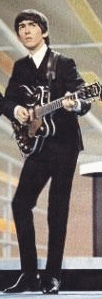 1963: 1963 Gretsch 6122 Country Gentleman:
In November, Harrison picked up another Gent at
Sound City, identical to his first except for the mutes,
which were flip-up rather than dial-up, and Harrison
came to prefer it. Seen on the Sullivan shows and
used on the '64 and '65 U.S. tours, this was the
guitar for the Beatles' first flush of worldwide
success. What happened to this guitar?
Brian O'Hara of The Fourmost, interviewed by Andy
Babiuk, said Harrison gave him the Country Gent during a
studio visit at Abbey Road and that he (O'Hara)
remembers trading it for something or other. But
in a recent
1963: 1963 Gretsch 6122 Country Gentleman:
In November, Harrison picked up another Gent at
Sound City, identical to his first except for the mutes,
which were flip-up rather than dial-up, and Harrison
came to prefer it. Seen on the Sullivan shows and
used on the '64 and '65 U.S. tours, this was the
guitar for the Beatles' first flush of worldwide
success. What happened to this guitar?
Brian O'Hara of The Fourmost, interviewed by Andy
Babiuk, said Harrison gave him the Country Gent during a
studio visit at Abbey Road and that he (O'Hara)
remembers trading it for something or other. But
in a recent 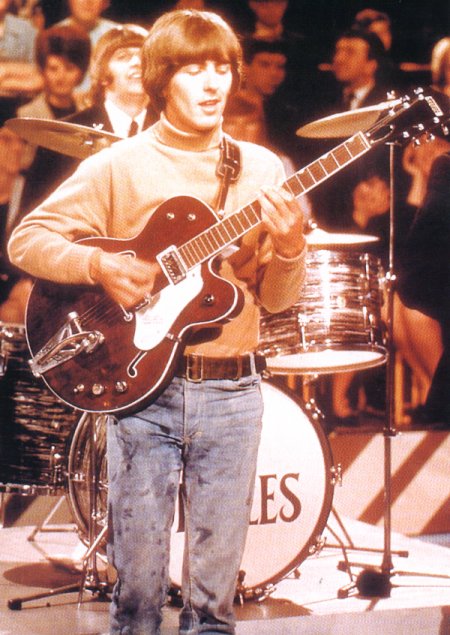 1963: Gretsch 6119 Tennessean (vintage '62 or
'63): Harrison found the perfect country-rock
twang he'd been looking for when he got this
double-pickup, single-cutaway "Type 2" model -- with
painted-on f-holes -- late in the year, and before long
it edged out the second Gent as his go-to guitar.
It's first spotted at the '63 Christmas shows, later at
Carnegie Hall, and used on the For Sale sessions
and for tours, concerts and TV appearances well into '65
-- most notably in the opening sequence of the film
"Help!" and at the triumphant first Shea Stadium concert
that August. It took a back seat for a while but
resurfaced for the Sgt. Pepper
sessions. Where is this guitar? In the
foreward for Jay Scott's Gretsch Book
(1992), Harrison says he owns a number of Gretsch
guitars, including a "1957 Tennessean, which to me is
the Eddie Cochran / Duane Eddy model." Apparently
he's referring to his model 6120, the "Chet Atkins"
hollow-body, a gift from his wife, and although in his Guitar
Player interview he provides photos of his
Gretsches, the '62/'63 Tennessean is not among
them. Likely it was stolen from a storage closet
at EMI's Abbey Road studio, along with a couple other
guitars.
1963: Gretsch 6119 Tennessean (vintage '62 or
'63): Harrison found the perfect country-rock
twang he'd been looking for when he got this
double-pickup, single-cutaway "Type 2" model -- with
painted-on f-holes -- late in the year, and before long
it edged out the second Gent as his go-to guitar.
It's first spotted at the '63 Christmas shows, later at
Carnegie Hall, and used on the For Sale sessions
and for tours, concerts and TV appearances well into '65
-- most notably in the opening sequence of the film
"Help!" and at the triumphant first Shea Stadium concert
that August. It took a back seat for a while but
resurfaced for the Sgt. Pepper
sessions. Where is this guitar? In the
foreward for Jay Scott's Gretsch Book
(1992), Harrison says he owns a number of Gretsch
guitars, including a "1957 Tennessean, which to me is
the Eddie Cochran / Duane Eddy model." Apparently
he's referring to his model 6120, the "Chet Atkins"
hollow-body, a gift from his wife, and although in his Guitar
Player interview he provides photos of his
Gretsches, the '62/'63 Tennessean is not among
them. Likely it was stolen from a storage closet
at EMI's Abbey Road studio, along with a couple other
guitars.